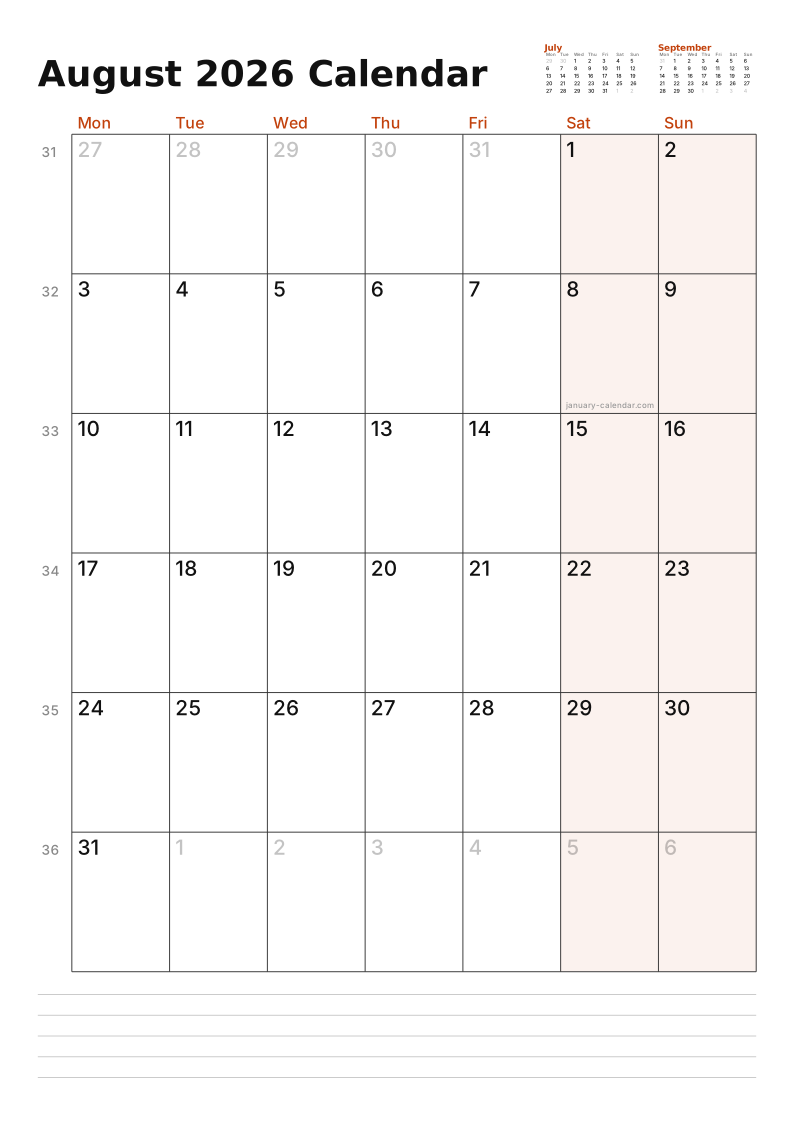
August 2026: two eclipses, ten weekend days
August 2026 arrived on Saturday 1 August and left on Monday 31 August, bookended by weekend arithmetic. Ten weekend days in all, the most generous month of the second half, and only 21 business days to show for the working year. The sky ran the programme: a total solar eclipse on Wednesday 12 August, the first over mainland Europe since 1999, and a partial lunar eclipse on the night of Friday 28 August. In between, the month carried some of the heaviest news of the year. It earned its rest.
Five weekends, end to end
The Saturdays were the 1st, 8th, 15th, 22nd and 29th. Sundays followed a day behind: the 2nd, 9th, 16th, 23rd and 30th. Mondays ran the 3rd, 10th, 17th, 24th and 31st. Ten weekend days came out of the arithmetic, and 21 business days carried the rest.
The month straddled ISO weeks 31 to 36, six week numbers in a single month. The final Monday stretched into a long weekend across much of Britain, a soft landing after a hard stretch. The grid, for once, looked generous.
Totality, then a shadow bite
On Wednesday 12 August the moon crossed the sun, and totality ran from Greenland across Iceland to northern Spain. It was the first total eclipse over mainland Europe since 1999. Britain and most of the continent saw a deep partial in the late afternoon. Eclipse chasers had booked their Icelandic rooms years earlier, which is faith with a deposit.
The month carried two farewells as well. Dolly Parton died in Nashville on Tuesday 25 August, aged 80, and with her an American summer took its bow. King Harald V of Norway died on Friday 28 August, aged 89, after thirty-five years on the throne. His son succeeded him at once as King Haakon VIII.
Two days after the eclipse, on Sunday 30 August, NASA launched the Nancy Grace Roman Space Telescope on a Falcon Heavy. A new great observatory, aimed at dark energy and distant worlds, rode out between the month's two sky shows. August had booked the entertainment and the follow-through.
A heavy month on the ground
The month's worst news came from the earth itself. An earthquake in western Colombia on Monday 10 August killed at least 288 people. Another struck off the Indonesian island of Flores on Saturday 15 August, killing at least 47. Flash floods from a glacial collapse hit the Nepal-Tibet border on Wednesday 26 August; the death toll passed 900.
Britain recorded its hottest day of the year, with wildfires in the hills. A commuter train derailed near Lewes, injuring about 20 people.
August closed quietly on its final Monday, the eclipse glasses still on the windowsill. September opened the next morning, on a Tuesday, with the equinox due on Wednesday 23 September.